
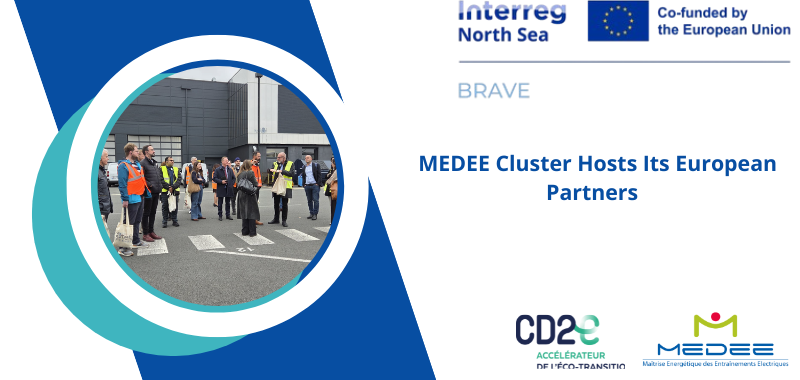
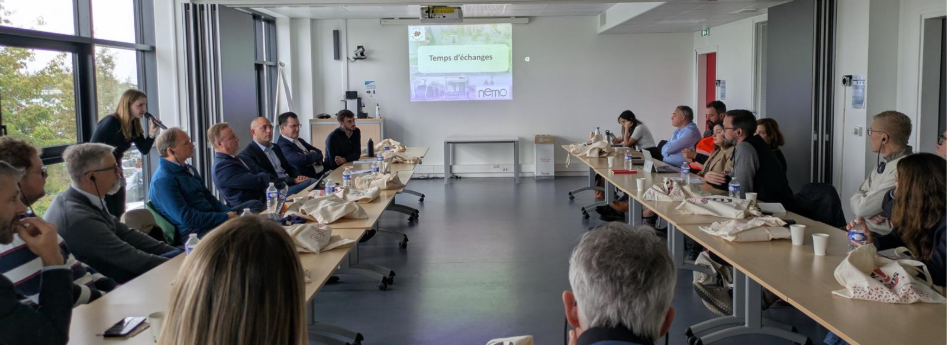
On October 14-15, 2025, the partners of the European BRAVE project met in Amiens and then Lille for their second annual meeting. During these two days, exchanges focused on a common goal: accelerating the deployment of clean energy solutions and strengthening public-private partnership models in Europe.
Moreover, this event, co-organized by the MEDEE and CD2E clusters with the support of local authorities, included plenary presentations, expert testimonials, a visit to Amiens’ electric bus depot, and collaborative workshops on investment readiness and innovation governance.
European demonstrators scaling up
By the end of the project’s first year, partners shared a mixed but clearly positive progress report. For instance, some demonstrators – such as Malmö, Flux50, or BOM – are focusing on building an initial investment case. Meanwhile, others, like Rotterdam and Hannoverimpuls, are adapting their existing innovation structures to foster new business models. Finally, the demonstrators in Amiens, Aarhus, and ASTER are working to strengthen their long-term strategies and replication plans.
When innovation becomes a political matter
Indeed, local policies play a key role in the success of energy transition projects, as the discussions highlighted. A telling example is Amiens Métropole: its €130 million electric bus fleet demonstrates how political decisions – such as partial free access to the network – directly affect the economic viability of such projects. Similarly, in Belgium, high network tariffs complicate local energy-sharing models, as highlighted by ASTER.
Toward new investment models
Given that public funding is decreasing, BRAVE partners agree on the need to mobilize more private investment. Currently, only 15–20% of climate transition financing needs are covered by public budgets. Consequently, the challenge is to create hybrid frameworks, combining public and private capital, to ensure the viability of large-scale decarbonization projects.
Cities: at the heart of the transition, but still under-resourced
Although cities play an increasingly important role in energy governance, their lack of human and financial resources still limits their capacity to manage large climate funds. Nevertheless, emerging initiatives, such as municipal climate funds led by Aarhus, demonstrate local authorities’ willingness to directly act on green financing levers.
Promote, share, inspire: communication at the heart of BRAVE
To conclude, the meeting emphasized the importance of international dissemination of BRAVE’s learnings. In particular, partners identified several strategic European events – Smart City Expo (Barcelona), European Sustainable Energy Week (Brussels), Cleantech Venture Days, etc. – to showcase their progress and attract new institutional and financial partners.
Looking ahead, the consortium’s next meeting will take place in Rotterdam, in May 2026.
To learn more about the BRAVE project
Un projet ? Contactez Sébastien DROUART, Directeur opérationnel